Is Floristry an Art or a Science?
Floristry•June 2026•5 min read
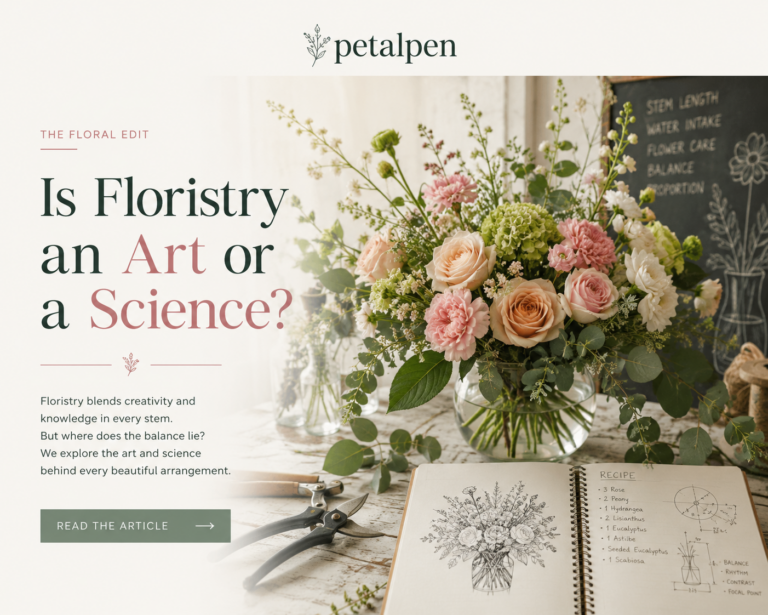
Floristry is often described as a creative profession, but there is far more to it than arranging beautiful flowers. Behind every bouquet, table center piece and floral installation is a mixture of artistic judgement, technical knowledge and practical skill. So, is floristry an art or a science? The most accurate answer is that it is both.
The Art of Floristry is an art because it depends heavily on creativity. A florist considers colors, shape, texture, movement and balance in much the same way that a painter approaches a canvas.
Flowers can be arranged to create a particular atmosphere or emotion. Soft pastel tones may feel romantic and gentle, while strong reds, oranges and purples can create something bold and dramatic. The choice of flowers, foliage and container all contributes to the final impression.
A florist must also think about proportion and composition. A successful arrangement needs a clear focal point, visual balance and a natural flow. These artistic decisions are rarely accidental. They come from experience, observation and an understanding of design.
Floristry can also be a form of personal expression. Two florists given the same selection of flowers may produce completely different arrangements. Their individual style, taste and imagination will shape the results.
The Science Behind the Flowers Floristry also relies on science. Flowers are living materials, and each variety has its own needs. A florist must understand how flowers absorb water, how temperature affects them and how quickly different varieties are likely to open or fade. Some stems need to be cut at a particular angle, while others may require special conditioning before they can be used.
Knowledge of plant biology helps florists keep flowers fresh for longer. Clean tools, suitable water temperatures, flower food and correct storage all play an important part.
There is also a practical science involved in constructing arrangements. Large displays must be stable, secure and safe. Wedding arches, hanging installations and event centerpiece require careful planning so that they remain attractive throughout the occasion.
Where Art and Science Meet, the best floristry happens when creativity and technical knowledge work together. An arrangement may look effortless, but its success often depends on careful preparation. The florist needs artistic vision to imagine the design and scientific understanding to make sure the flowers survive, remain secure and perform as intended.
This combination is what makes floristry such a skilled profession. It is not simply about choosing attractive flowers. It is about understanding the materials, solving practical problems and creating something meaningful.
Floristry as a Living Art Form Unlike painting or sculpture, floral design is temporary. Flowers change from the moment they are cut. Buds open, petals soften and colors gradually fade. This temporary quality gives floristry a special character. A floral arrangement is a living artwork that develops over time. Its beauty may not last forever, but that is part of what makes it memorable.
The Final Answer Floristry is both an art and a science. It is an art because it uses color, form, texture and imagination. It is a science because it requires knowledge of plants, conditioning, structure and preservation. A talented florist combines both disciplines, using technical expertise to bring a creative idea to life. That balance is what transforms a group of flowers into a thoughtful and expressive design.
Inspired by flowers and botanical storytelling?
Whether you're looking for floral styling, creative collaborations, or wearable art inspired by nature,
I'd love to connect.